

External parts of an airplane
From Planepedia, the free and crappy encyclopedia about planes
This article is about the external parts of an airplane
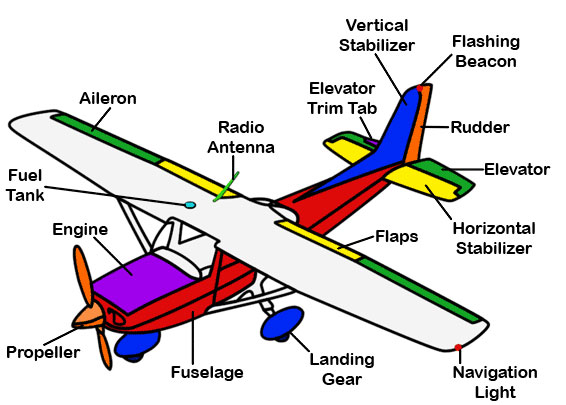
Airplanes consist of many different parts that work together, making it thrust up into the air and fly. They are designed to use the help of external forces like air molecules that interact with the parts, producing more thrust and less resistance.
Fuselage
The word originated from the French word ‘fuseau’, meaning ‘spindle’.
The fuselage is the main part of the airplane that basically connects everything together. The cockpit is at the front of the fuselage, where the pilot controls the plane, and the back of the fuselage is where other things are, like passengers and cargo. The shape of the fuselage is designed to reduce drag, which is the opposite force that thrusts the plane forward.
There are different types of fuselage designs used throughout history, and have their pros and cons.
The truss fuselage is made of lightweight metal or wood, and it was easy to contruct, and has a reliable structure. It was mostly used in early aircraft days, and it is not as efficient as other designs. It's a heavy design, which can cause issues like using more fuel and making lots of noise.
The geodesic fuselage is a structure of triangular and hexogonal frames made of metal or synthetic materials. It became popular during WWII, It is considered stronger than a lot of other fuselage designs, and it provides a solid shape, however it was extremely hard to construct.
The monocoque fuselage